
Life can become busy before we even realize it. Work, school, family responsibilities, and daily tasks often fill our afternoons. In the middle of all this, Asr prayer gives Muslims a chance to pause, remember Allah, and find peace.
It is a beautiful reminder that no matter how busy life becomes, our relationship with Allah should always come first.
If you are searching for how to pray Asr step by step, this guide is written especially for you. Whether you are a beginner, a new Muslim, or someone who wants to refresh their knowledge, you will find clear and easy instructions here.
You will learn the importance of Asr prayer, when to pray it, how many Rak’ahs it has, what to recite, and the correct steps to perform it.
By the end of this guide, you will feel more confident praying Asr with sincerity and devotion.
What Is Asr Prayer?
Asr is the third of the five daily prayers that every Muslim performs. It is prayed in the afternoon after Dhuhr and before Maghrib. The prayer consists of four obligatory (Fard) Rak’ahs.
Allah says in the Quran:
“Guard strictly your prayers, especially the middle prayer, and stand before Allah with devotion.” (Quran 2:238)
Many Islamic scholars explain that the “middle prayer” refers to the Asr prayer, showing its special importance. Praying Asr on time strengthens your faith and reminds you to keep Allah at the center of your day.
How to Pray Asr for Kids
- Kids should learn Asr prayer step by step without feeling rushed.
- Start by teaching the child to make wudu correctly.
- Explain that Asr prayer has four Fard rak‘ahs.
- Teach the child to face the Qiblah before starting Salah.
- Help the child learn the intention for Asr prayer.
- Teach Takbir, standing, Ruku, and Sujood one step at a time.
- Encourage the child to learn Surah Al-Fatihah and short Surahs.
- Show the child how to sit for Tashahhud.
- Teach the child to complete the prayer with Salam.
- Praise the child for making an effort to learn Salah.
Pray Asr Time
- Asr is the afternoon prayer and has a specific time in the daily prayer schedule.
- Muslims should pray Asr within its prescribed time.
- The exact beginning and ending time of Asr changes according to location and date.
- A local prayer timetable can help you find the correct Asr time.
- Children can learn Asr time by following a daily Salah schedule.
- Try to prepare for Asr before the prayer time arrives.
- Make wudu early if you know you will be busy later.
- Avoid unnecessarily delaying Asr until its time is nearly over.
- Parents can remind children gently when Asr time begins.
- Learning the prayer times helps children develop a regular Salah habit.
How to Pray Asr for Men
- A man begins Asr by making the intention to pray four Fard rak‘ahs.
- He stands facing the Qiblah and begins with Takbir.
- Asr Fard consists of four rak‘ahs.
- The first two rak‘ahs include Al-Fatihah followed by another Surah when praying individually.
- Ruku and Sujood are performed calmly in every rak‘ah.
- After the second rak‘ah, he sits and recites Tashahhud.
- He then stands for the third rak‘ah.
- In the third and fourth Fard rak‘ahs, the recitation is silent.
- After the fourth rak‘ah, he sits for the final Tashahhud and other prescribed supplications.
- He completes the prayer by turning right and left with Salam.
How to Pray Asr Fard
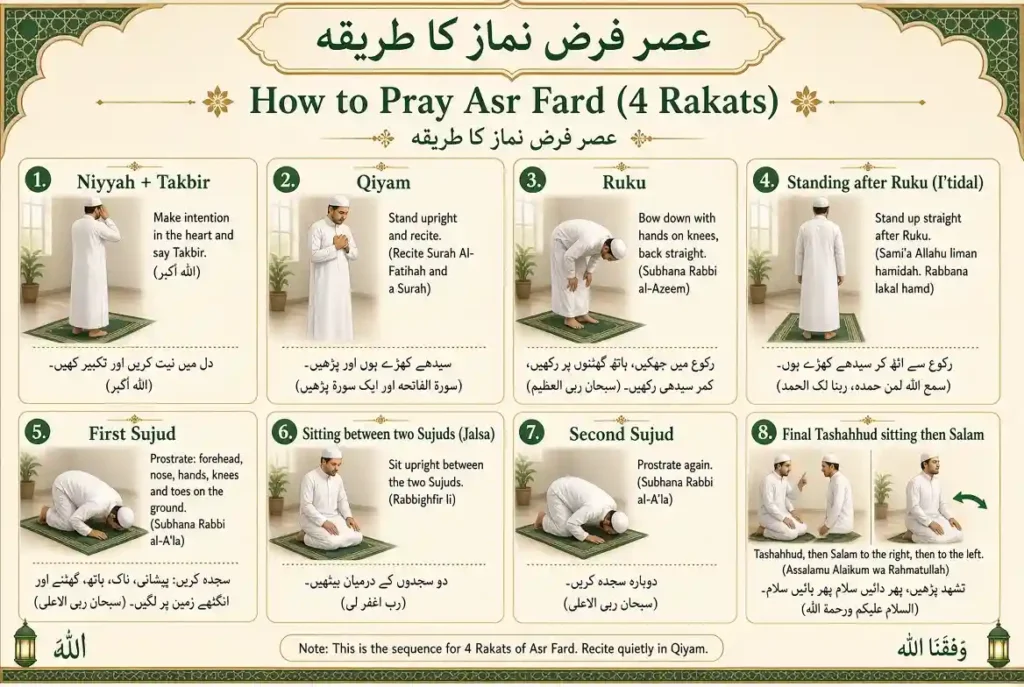
- Asr Fard consists of four obligatory rak‘ahs.
- Begin by making the sincere intention for four Fard rak‘ahs of Asr.
- Face the Qiblah and say Allahu Akbar to begin Salah.
- Perform the first rak‘ah with standing, recitation, Ruku, and two Sujoods.
- Perform the second rak‘ah in the same basic manner.
- Sit after the second rak‘ah and recite Tashahhud.
- Stand for the third rak‘ah and continue the prayer.
- Complete the fourth rak‘ah with Ruku and two Sujoods.
- Sit after the final Sujood for Tashahhud and the prescribed supplications.
- Finish the four-rak‘ah Fard prayer with Salam.
How to Pray Asr Namaz Behind Imam
- Make the intention to pray the four Fard rak‘ahs of Asr behind the Imam.
- Stand properly in the congregation and face the Qiblah.
- Begin the prayer after the Imam begins with Takbir.
- Follow the Imam throughout the prayer and do not move ahead of him.
- When the Imam goes into Ruku, follow him after he does so.
- When the Imam performs Sujood, follow him into Sujood.
- In the Hanafi school, the person following the Imam does not recite Al-Fatihah or another Surah behind him in Asr.
- Continue with the Imam through all four rak‘ahs.
- Remain seated for Tashahhud when the Imam sits.
- Complete the prayer with the Imam when he performs the final Sala
Before You Begin Asr Prayer
Before praying, make sure you are prepared.
- Perform Wudu (Ablution).
- Wear clean and modest clothing.
- Find a clean place to pray.
- Face the Qiblah.
- Make your Niyyah (intention) in your heart to pray the four Fard Rak’ahs of Asr.
You do not need to say the intention aloud. Allah knows what is in your heart.
How to Pray Asr Step by Step
Follow these simple steps:
First Rak’ah
- Raise both hands and say Allahu Akbar.
- Place your hands in the prayer position.
- Recite Surah Al-Fatihah.
- Recite another short Surah, such as Surah Al-Ikhlas.
- Bow into Ruku, saying Subhana Rabbiyal Azeem three times.
- Stand up, saying Sami’ Allahu liman hamidah.
- Perform the first Sujood.
- Sit briefly.
- Perform the second Sujood.
Second Rak’ah
Repeat the same steps as the first Rak’ah. After the second Sujood, sit and recite the Tashahhud, then stand up for the third Rak’ah.
Third Rak’ah
Recite only Surah Al-Fatihah, then complete the Ruku and Sujood as before.
Fourth Rak’ah
Again, recite Surah Al-Fatihah, complete the prayer movements, then sit for the final Tashahhud, recite Durood Ibrahim, make a personal dua if you wish, and finish by turning your head to the right and left, saying:
Assalamu Alaikum wa Rahmatullah.
What Should You Recite During Asr Prayer?
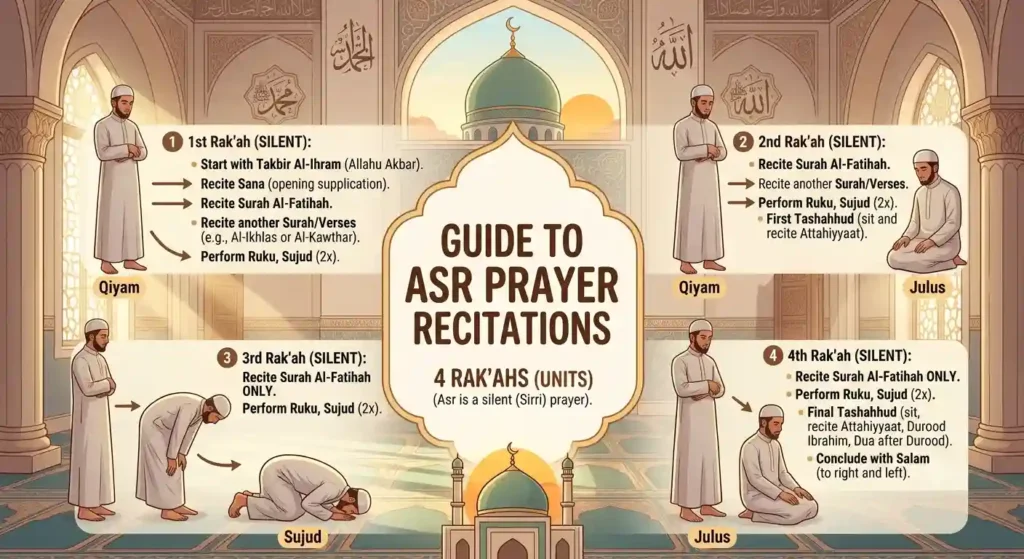
In the first two Rak’ahs, recite:
- Surah Al-Fatihah
- Any short Surah from the Quran
Popular choices include:
- Surah Al-Ikhlas
- Surah Al-Asr
- Surah Al-Kawthar
- Surah An-Nas
- Surah Al-Falaq
In the third and fourth Rak’ahs, recite Surah Al-Fatihah only before continuing with the prayer.
Common Mistakes to Avoid
Many people make small mistakes while learning Salah. Here are some common ones:
- Praying before Asr time begins.
- Rushing through Ruku and Sujood.
- Forgetting to perform Wudu correctly.
- Looking around during prayer.
- Missing one of the four Rak’ahs.
- Not praying with focus and sincerity.
Remember, Allah loves those who try their best. If you make a mistake while learning, continue practicing and ask Allah for guidance.
Benefits of Praying Asr Daily
Praying Asr every day has many spiritual benefits.
It reminds you to stop and remember Allah during a busy afternoon. It strengthens your relationship with your Creator and brings peace to your heart. Asr prayer also teaches discipline because it encourages you to organize your daily schedule around worship.
Many Muslims find that praying Asr helps reduce stress, improves patience, and fills the rest of the day with blessings. Even a few peaceful minutes spent in Salah can refresh your heart and mind.
Tips to Improve Your Asr Prayer
If you want to improve your Salah, keep these simple tips in mind:
- Pray as soon as the prayer time begins.
- Learn the meaning of Surah Al-Fatihah.
- Turn off distractions like your phone.
- Pray slowly instead of rushing.
- Think about standing before Allah.
- Make dua after every prayer.
Small improvements each day can make your prayer more meaningful.
How to Pray Asr Namaz for Female
- Make Niyyah: Make the intention in your heart to pray four rak‘ahs of Fard Asr prayer for the sake of Allah SWT.
- Perform Wudu: Make sure you have completed wudu and are in a clean place with your body and clothes properly covered.
- Stand for Prayer: Face the Qiblah and stand respectfully. A woman should cover her body appropriately according to Islamic guidelines.
- Begin with Takbeer: Raise your hands appropriately and say Allahu Akbar to begin the prayer.
- Recite Surah Al-Fatihah: Recite Surah Al-Fatihah, followed by another Surah or some verses from the Qur’an where required.
- Perform Ruku: Say Allahu Akbar and bow in ruku. Keep your posture respectful and say Subhana Rabbiyal Adheem.
- Perform Sujood: After standing briefly, go into sujood and say Subhana Rabbiyal A‘la. Complete two prostrations in each rak‘ah.
- Complete the Four Rak‘ahs: Continue the prayer until all four rak‘ahs of the Fard Asr prayer are completed.
- Recite Tashahhud: Sit and recite At-Tahiyyat, followed by Durood Ibrahim and the appropriate dua in the final sitting.
- Finish with Salam: Turn your face to the right and then to the left, saying Assalamu Alaikum wa Rahmatullah each time, completing the Asr prayer.
Frequently Asked Questions
1. How many Rak’ahs are in Asr prayer?
Asr prayer consists of four obligatory (Fard) Rak’ahs. These four Rak’ahs are required for every adult Muslim who is able to pray.
2. Is Asr prayer silent or loud?
Asr is a silent prayer. The Quran is recited quietly, unlike Fajr, Maghrib, and Isha, where some Rak’ahs are recited aloud.
3. Can I pray Asr just before sunset?
Yes, you can pray Asr before sunset if the prayer time has not ended. However, it is always better to pray earlier without unnecessary delay.
4. What Surah should I read in Asr prayer?
After Surah Al-Fatihah, you may recite any portion of the Quran in the first two Rak’ahs. Beginners often choose shorter Surahs because they are easier to memorize.
5. What if I forget a part of the prayer?
If you forget a minor part of your prayer, learn the rules of Sujood As-Sahw (prostration of forgetfulness) from a knowledgeable scholar. Continue learning and improving your Salah with patience.
Conclusion
Learning how to pray Asr step by step is an important part of growing as a Muslim. Asr prayer is more than a daily obligation. It is a chance to pause, thank Allah for His blessings, and seek His guidance before the day comes to an end. Even if you are still learning, do not worry. Every sincere effort is rewarded by Allah. Make it your goal to pray Asr on time every day. With regular practice, the movements and recitations will become familiar, and your confidence will grow.
May Allah accept your prayers, strengthen your faith, and make Salah a source of peace, happiness, and guidance in your life. Ameen.

PrayerLoomz is a faith-centered platform dedicated to helping Muslims find meaningful prayers, duas, Quranic guidance, and Islamic reminders for everyday life. Our content is written with respect for Islamic teachings and aims to provide simple, reliable, and spiritually uplifting guidance for Muslims around the world. We focus on prayers for different life situations, Islamic duas, Quran verses, authentic Hadith references, and practical faith-based reminders. Our goal is to make Islamic knowledge easier to understand while encouraging readers to strengthen their connection with Allah SWT. At PrayerLoomz, we value accuracy, sincerity, and respectful presentation of Islamic teachings. We encourage readers to verify matters of religious ruling with qualified Islamic scholars when necessary.