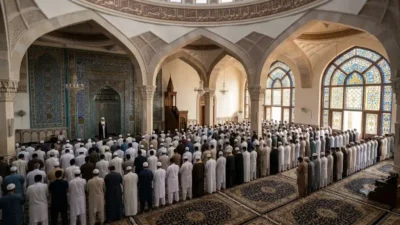
The day can be long and tiring. After work, school, or family responsibilities, many people look for a moment of peace before going to sleep. Isha prayer offers that peaceful ending to the day.
It is a time to leave behind stress, thank Allah SWT, and ask for His guidance and protection through the night.
If you are searching for how to pray Isha step by step, this guide is written just for you. Whether you are a beginner, a new Muslim, or someone who wants to refresh their knowledge, you will find easy-to-follow instructions here.
Learning the correct way to pray Isha can help you build a stronger connection with Allah, improve your daily routine, and bring comfort to your heart.
With regular practice, this daily Isha prayer becomes a beautiful habit that fills every night with faith and hope.
What Is Isha Prayer?
Isha is the fifth and final obligatory prayer of the day. It is performed after the evening twilight disappears and before the time of Fajr begins. Every adult Muslim is required to pray Isha unless there is a valid Islamic excuse.
The obligatory part of Isha prayer is 4 Fard Rak’ahs. Many Muslims also pray the Sunnah prayers and Witr after the Fard prayer because they were regularly performed by Prophet Muhammad ﷺ.
How to Pray Isha for Women
- Women pray the obligatory Isha prayer as four rak‘ahs, with the usual conditions of salah.
- Begin by making the intention for Isha and face the Qiblah.
- Start the prayer by saying Allahu Akbar.
- Recite Surah Al-Fatihah and another surah in the first two rak‘ahs.
- Perform ruku‘, then stand upright before going into sujood.
- Complete two rak‘ahs and sit for the first tashahhud.
- Stand for the third and fourth rak‘ahs and complete the required recitations.
- Sit for the final tashahhud after the fourth rak‘ah.
- End the prayer with salam to the right and left.
- Women should learn the details from a trusted scholar according to their madhhab, because some prayer details differ.
How to Pray Isha Witr
- Witr is prayed after Isha and before Fajr.
- The number of Witr rak‘ahs differs according to the school of Islamic jurisprudence.
- In the Hanafi school, Witr is commonly prayed as three rak‘ahs.
- Make the intention for Witr before beginning.
- Pray the first two rak‘ahs normally and sit for tashahhud.
- Stand for the third rak‘ah and recite Al-Fatihah followed by another surah.
- In the Hanafi method, the additional takbeer and Dua Qunoot are included in the third rak‘ah.
- Complete the final ruku‘, sujood, tashahhud, and salam.
- Witr is an important night prayer and should be prayed consistently.
- If you are a beginner, learn the exact Witr method followed by your local trusted teacher or imam.
How to Pray Isha for Beginners
- First, learn the basic requirements of salah, including wudu, cleanliness, covering the awrah, and facing the Qiblah.
- Isha begins after twilight has disappeared and its time continues until Fajr, with details differing among scholars.
- Make the intention for the Isha prayer.
- Begin with Allahu Akbar and follow the prayer step by step.
- Learn Surah Al-Fatihah first because it is essential in salah.
- Add a short surah that you know, such as Surah Al-Ikhlas.
- Learn the basic words of ruku‘, sujood, tashahhud, and salam.
- Do not worry if you need time to memorize everything.
- Practice regularly so the movements and recitations become familiar.
- Ask a knowledgeable imam or teacher to correct your prayer if you are unsure about any step.
How to Pray Isha Namaz 17 Rakat
- The commonly followed Hanafi schedule can total 17 rak‘ahs when the sunnah, fard, nafl, and Witr prayers are counted together.
- This commonly includes 4 rak‘ahs of Sunnah before Isha.
- Then 4 rak‘ahs of Fard Isha are prayed.
- After the Fard, 2 rak‘ahs of Sunnah Mu’akkadah are prayed.
- Some people then pray 2 rak‘ahs of nafl.
- Witr is commonly prayed as 3 rak‘ahs in the Hanafi school.
- An additional 2 rak‘ahs of nafl can bring the total to 17.
- Not every Muslim follows the same counting method for Isha.
- The obligatory part of Isha is the 4-rak‘ah Fard prayer.
- Because rak‘ah counts can vary by madhhab and how voluntary prayers are counted, beginners should follow a reliable teacher’s method.
How to Pray Isha Namaz Rakat
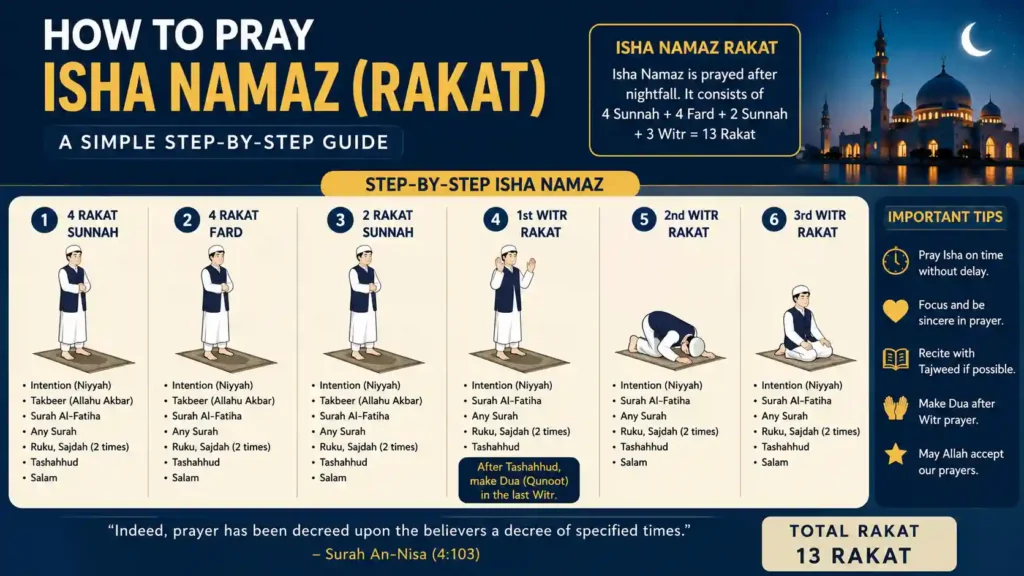
- The Fard portion of Isha consists of 4 rak‘ahs.
- Many Muslims also pray 4 rak‘ahs of Sunnah before the Fard.
- After the Fard, 2 rak‘ahs of Sunnah Mu’akkadah are commonly prayed.
- Additional nafl prayers may also be offered.
- Witr is prayed after Isha and is especially emphasized in the Hanafi school.
- In the Hanafi school, Witr consists of 3 rak‘ahs.
- The exact total number of Isha rak‘ahs depends on which Sunnah and nafl prayers are included.
- The four Fard rak‘ahs should be learned carefully because they are obligatory.
- Beginners should avoid becoming confused by different ways of counting Sunnah and nafl prayers.
- Follow a reliable Islamic teacher or the established practice of your madhhab for the complete Isha routine.
Isha Namaz 9 Rakat
- Some people use 9 rak‘ahs to refer to a particular combination of Isha prayers.
- The exact combination should be clarified because different communities count Sunnah, Fard, and Witr differently.
- The 4-rak‘ah Fard of Isha is obligatory.
- The 2-rak‘ah Sunnah after Isha is commonly emphasized.
- Witr is also prayed after Isha.
- In the Hanafi school, Witr consists of 3 rak‘ahs.
- Adding 4 Fard, 2 Sunnah, and 3 Witr gives a total of 9 rak‘ahs.
- This is why you may see Isha described as 9 rak‘ahs in some guides.
- Additional Sunnah and nafl prayers can make the total higher.
- When learning Isha, focus first on the obligatory 4 rak‘ahs and then learn the additional prayers according to your madhhab.
How to Pray Isha Step by Step
Follow these simple steps:
1. Make Wudu
Perform Wudu if you are not already in a state of purification. Cleanliness is an important condition for Salah.
2. Face the Qiblah
Stand facing the Ka’bah in Makkah. Make sure your clothes and prayer place are clean.
3. Make the Intention (Niyyah)
Quietly make the intention in your heart to pray the 4 Fard Rak’ahs of Isha for the sake of Allah.
4. Begin the Prayer
Raise both hands and say:
Allahu Akbar
(Allah is the Greatest)
Fold your hands on your chest or below it according to your Islamic school of thought.
5. Recite Surah Al-Fatihah
Begin by reciting Surah Al-Fatihah.
In the first two Rak’ahs, recite another Surah after Al-Fatihah, such as Surah Al-Ikhlas.
6. Go into Ruku
Say Allahu Akbar and bow.
Recite three times:
Subhana Rabbiyal Azeem
Then stand back up saying:
Sami’ Allahu liman hamidah
Then say:
Rabbana wa lakal hamd
7. Perform Sujood
Say Allahu Akbar and go into prostration.
Recite three times:
Subhana Rabbiyal A’la
Sit briefly and perform the second Sujood.
8. Complete All Four Rak’ahs
Repeat the same steps.
After the second Rak’ah, sit and recite At-Tahiyyat.
After the fourth Rak’ah, recite At-Tahiyyat, Durood Ibrahim, and a supplication before ending the prayer.
9. End the Prayer
Turn your head to the right and say:
Assalamu Alaikum wa Rahmatullah
Then turn to the left and repeat it.
Your 4 Fard Rak’ahs of Isha are now complete.
Recommended Rak’ahs of Isha
Many Muslims perform Isha in this order:
- 4 Sunnah (optional)
- 4 Fard (obligatory)
- 2 Sunnah Mu’akkadah
- 2 Nafl (optional)
- 3 Witr
- 2 Nafl (optional)
The most important part is the 4 Fard Rak’ahs, while the Sunnah and Witr prayers bring extra reward.
Benefits of Praying Isha Daily
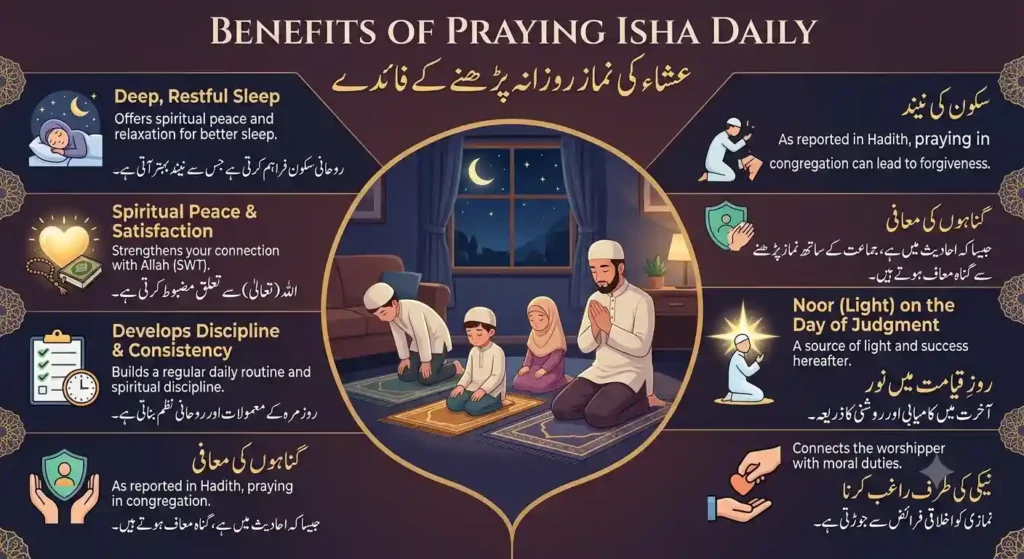
Praying Isha every night brings many blessings.
- It strengthens your relationship with Allah.
- It helps you end the day with gratitude.
- It brings peace before sleeping.
- It reminds you to seek forgiveness every night.
- It builds discipline and good habits.
- It increases spiritual strength during difficult times.
Even a short Isha prayer performed with sincerity is better than delaying or missing it.
Common Mistakes to Avoid
When learning how to pray Isha step by step, avoid these common mistakes:
- Rushing through the prayer.
- Forgetting proper Wudu.
- Missing parts of the recitation without trying to learn them.
- Praying without focus.
- Delaying Isha until its time has almost ended without a valid reason.
Take your time and pray with a calm heart. Allah loves sincere effort.
Conclusion
Learning how to pray Isha step by step is one of the best ways to grow closer to Allah. Every night, Isha gives you a chance to thank Him for the blessings of the day, ask for forgiveness, and place your worries in His hands. You do not need to be perfect. Start with sincerity, learn one step at a time, and continue improving your prayer.
May Allah SWT accept your Isha prayer, strengthen your faith, forgive your sins, and fill your nights with peace, mercy, and guidance.
Ameen.
Frequently Asked Questions
1. How many Rak’ahs are in Isha prayer?
The obligatory Isha prayer has 4 Fard Rak’ahs. Many Muslims also pray Sunnah, Nafl, and Witr prayers.
2. Can beginners pray Isha even if they do not know every Surah?
Yes. Start by learning Surah Al-Fatihah and a short Surah. Keep practicing every day.
3. What time does Isha prayer begin?
Isha begins after the evening twilight disappears and continues until the start of Fajr.
4. Is Witr part of Isha prayer?
Witr is prayed after Isha and is highly emphasized in Islam. Many scholars encourage Muslims not to leave it.
5. Why is Isha prayer important?
Isha is one of the five daily prayers. It helps strengthen faith, brings peace to the heart, and ends the day with the remembrance of Allah.

PrayerLoomz is a faith-centered platform dedicated to helping Muslims find meaningful prayers, duas, Quranic guidance, and Islamic reminders for everyday life. Our content is written with respect for Islamic teachings and aims to provide simple, reliable, and spiritually uplifting guidance for Muslims around the world. We focus on prayers for different life situations, Islamic duas, Quran verses, authentic Hadith references, and practical faith-based reminders. Our goal is to make Islamic knowledge easier to understand while encouraging readers to strengthen their connection with Allah SWT. At PrayerLoomz, we value accuracy, sincerity, and respectful presentation of Islamic teachings. We encourage readers to verify matters of religious ruling with qualified Islamic scholars when necessary.