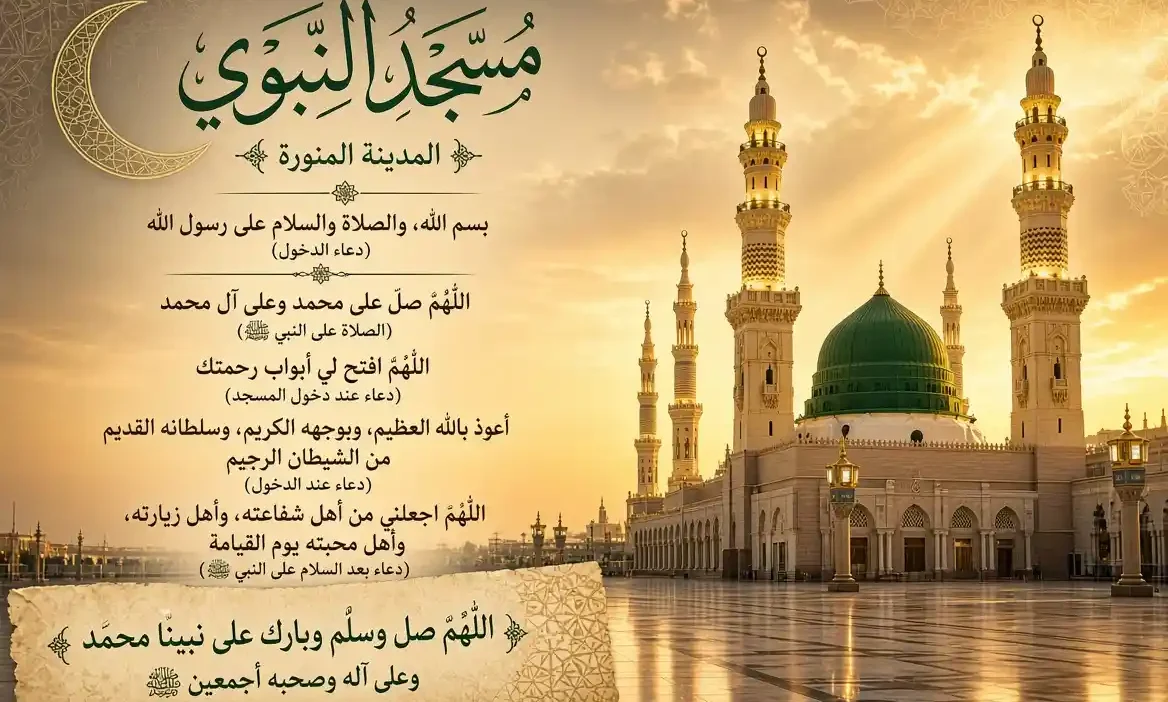
There are some journeys that change the heart before they even begin. A visit to Masjid Nabawi ﷺ in Madinah is one of them. You may spend months saving, planning, and making travel arrangements, but when you finally see the blessed mosque, the feeling can be hard to describe. Many people become quiet, emotional, and deeply grateful.
If you are searching for duas for visiting Masjid Nabawi, this guide is written for you. Whether you are preparing for your first visit or returning to a place you love, knowing what to say can help you stay focused on Allah and follow the Sunnah.
Masjid Nabawi has a special place in Islam. The Prophet Muhammad ﷺ called it one of the three mosques to which a person may undertake a special religious journey.
One important point is worth remembering: there is no single special dua that must be recited only for visiting Masjid Nabawi. Instead, you can use authentic duas for entering the mosque, worship, forgiveness, guidance, and sending peace and blessings upon the Prophet ﷺ. You may also make sincere personal dua to Allah in your own words.
1. Dua for Entering Masjid Nabawi
When you reach Masjid Nabawi, pause for a moment. You have arrived at a place connected to the life and worship of the Prophet Muhammad ﷺ. Enter calmly and with humility.
A well-known authentic dua for entering any mosque is:
Arabic:
اللَّهُمَّ افْتَحْ لِي أَبْوَابَ رَحْمَتِكَ
Transliteration:
Allahumma iftah li abwaba rahmatik.
Meaning:
O Allah, open for me the doors of Your mercy.
This dua is reported in Sahih Muslim. It is not exclusive to Masjid Nabawi, but it is a beautiful Sunnah to remember when entering this blessed mosque.
O Allah, as I enter this blessed mosque, open my heart to Your mercy. Remove the noise of the world from my mind. Help me worship You with sincerity. Let every step I take bring me closer to You. Forgive my mistakes and accept my worship. Allow me to leave this mosque with a softer heart, stronger faith, and a greater love for Your Messenger ﷺ. Ameen.
2. Dua for Sending Salam Upon the Prophet ﷺ
Visiting Madinah naturally brings the heart toward the Prophet Muhammad ﷺ. When you visit his resting place, greet him respectfully and calmly.
You may say:
As-salamu ‘alayka ayyuhan-Nabiyyu wa rahmatullahi wa barakatuhu.
Meaning:
Peace be upon you, O Prophet, and the mercy of Allah and His blessings.
You can then send salawat upon him, such as:
Allahumma salli ‘ala Muhammad wa ‘ala ali Muhammad.
The purpose is not to ask the Prophet ﷺ for something that only Allah can grant. Rather, direct your requests to Allah alone, while sending salam and blessings upon His Messenger ﷺ.
O Allah, bless Your beloved Messenger Muhammad ﷺ. Allow me to follow his Sunnah with love and sincerity. Make my visit a reminder of his mercy, patience, courage, and devotion to You. Help me live by the beautiful example he left for this Ummah. Let my salam be sincere and my heart full of respect. O Allah, gather me with Your righteous servants and grant me the Prophet’s ﷺ intercession by Your mercy on the Day when I need it most. Ameen.
3. Powerful Dua for Forgiveness in Masjid Nabawi
A visit to Madinah can be a perfect moment for honest repentance. You may remember sins from years ago, missed prayers, broken promises, hurtful words, or times when your heart became distant from Allah.
Do not let those memories make you hopeless.
Turn them into dua.
Astaghfirullaha wa atubu ilayh means: I seek Allah’s forgiveness and repent to Him.
You can also make a personal dua in simple words.
O Allah, I come before You with all my weaknesses. You know every mistake I have made, including those I remember and those I have forgotten. Forgive me completely. Clean my heart from sins and pride. Help me leave bad habits behind. Give me the strength to return to You whenever I fall. Do not let this blessed journey be only a beautiful memory. Let it become a turning point in my life. Forgive my parents, family, teachers, friends, and all Muslims. Cover our faults and guide us toward what pleases You. Ameen.
4. Short Dua for Guidance and a Stronger Faith
Sometimes we travel to Madinah with a long list of things we want from Allah. Yet one of the greatest gifts we can ask for is guidance.
Money can disappear. Health can change. Plans can fail. But guidance can transform every part of life.
A simple Quranic dua is:
Rabbana la tuzigh qulubana ba‘da idh hadaytana wa hab lana milladunka rahmah, innaka antal-Wahhab.
Meaning:
Our Lord, do not let our hearts deviate after You have guided us, and grant us mercy from You. Surely, You are the Bestower.
O Allah, keep my heart firm upon Your guidance. Do not allow the difficulties of life to pull me away from You. Give me faith that remains strong when life is easy and when life is hard. Help me understand the Quran, love prayer, follow the Sunnah, and choose what is right even when it is difficult. Let my visit to Madinah increase my iman instead of becoming only a travel memory. Guide my family and loved ones too. Keep our hearts close to You until our final breath. Ameen.
5. Dua for Peace and a Calm Heart
Travel can be tiring. Crowds can be overwhelming. You may also arrive in Madinah carrying worries that nobody else can see.
Perhaps you are worried about your marriage, children, finances, work, health, or future.
Bring those worries to Allah.
You can make a spiritual dua for peace in your own language. There is no requirement that every personal dua must be in Arabic.
O Allah, You know the worries hidden inside my heart. You know what keeps me awake at night and what I cannot explain to anyone. Give me peace that comes from trusting You. Replace my fear with calm and my confusion with clarity. Help me remember that nothing is beyond Your power. When I feel weak, give me strength. When I feel lost, guide me. When I feel alone, remind me that you are near. Let the peaceful atmosphere of Madinah renew my heart and help me return home with greater patience, gratitude, and trust in You. Ameen.
6. Dua for Family and Loved Ones
Many people reach Masjid Nabawi carrying the names of loved ones in their hearts. You may remember your parents, spouse, children, siblings, friends, or someone who could not make the journey with you.
This is a beautiful time to ask Allah to care for them.
O Allah, bless my family and everyone I love. Protect them wherever they are. Give our parents health, mercy, and forgiveness. Guide our children and make them people of faith, good character, and wisdom. Bring peace into our homes and remove anger, jealousy, and misunderstanding from our hearts. Heal relationships that have been damaged. Help us forgive one another before it is too late. Give our families halal provision, good health, safety, and contentment. If someone I love is struggling, make a way out for them. If someone is far from You, guide them gently back to You. Ameen.
7. Dua for Strength in Hard Times
A visit to Masjid Nabawi does not mean that every problem will disappear immediately. Life will still have tests after you return home.
That is why asking Allah for strength in hard times is so important.
You can say:
Hasbunallahu wa ni‘mal-wakil.
Meaning:
Allah is Sufficient for us, and He is the Best Disposer of affairs.
Then speak to Allah honestly.
O Allah, give me strength for the tests I cannot carry alone. When my plans fail, help me trust Your plan. When people disappoint me, protect my heart from bitterness. When I lose something I love, give me patience and replace my loss with something better. When I become tired, remind me that you see every effort. Make me strong without making my heart hard. Give me sabr when I cannot change my situation and wisdom when I can. Let this visit teach me that real strength comes from depending on You. Ameen.
8. Dua for Acceptance of Worship
One of the most important things to ask Allah for is acceptance.
A person may perform many acts of worship, but the believer still asks Allah to accept them.
The Quran teaches us a beautiful dua:
Rabbana taqabbal minna innaka antas-Sami‘ul-‘Alim.
Meaning:
Our Lord, accept from us. Indeed, You are the All-Hearing, the All-Knowing.
Use this dua during your visit and after prayer.
O Allah, accept every prayer I offer, every tear I shed, every word of remembrance I speak, and every good intention in my heart. Do not let my worship be mixed with pride or the desire for praise. Make it only for You. Accept my visit to Masjid Nabawi and accept the prayers I make here. Accept my repentance and my efforts to become better. Give me the ability to continue worshipping You after I leave Madinah. Let the good changes I began here continue when I return home. Ameen.
9. Dua for Returning Home With a Changed Heart
The real test of a blessed journey begins when the journey ends.
It is easy to feel close to Allah in a sacred place. The goal is to carry that closeness into ordinary life.
Make this a daily dua after your visit:
O Allah, do not let me return home as the same person who arrived. Change my heart for the better. Make me more regular in prayer, more careful with my words, more patient with my family, and more honest in my work. Help me avoid sins that I once treated lightly. Make the Quran a source of guidance in my daily life. Help me follow the Sunnah of Your Prophet ﷺ with love and understanding. When I become weak, bring me back to You. Let my memories of Madinah inspire better choices instead of only making me miss the place. Ameen.
10. Dua for the Blessing of Returning to Madinah
Many visitors leave Madinah with tears because they know they may not know when they will return.
It is natural to hope for another visit.
There is no need to claim that a particular special dua for returning to Masjid Nabawi is required. Instead, ask Allah sincerely for another opportunity if it is good for you.
O Allah, if it is good for me, bless me with another visit to Madinah. Bring me back to Masjid Nabawi with a healthy body, sincere heart, and stronger faith. Give me the means to travel again and allow me to worship You there with humility. If I cannot return, keep the love of Your Messenger ﷺ alive in my heart wherever I am. Let me remember the lessons I learned in Madinah and live by them. Give me the blessing of visiting again with my family and loved ones if You have written it for us. Until then, make my home a place of prayer, remembrance, peace, and gratitude. Ameen.
What Should You Remember When Visiting Masjid Nabawi?
The most important thing is to remember that Allah alone is the One you ask for help, forgiveness, guidance, healing, and every blessing.
Masjid Nabawi is a deeply honored mosque, and the Prophet ﷺ specifically mentioned his mosque among the three mosques to which a religious journey may be undertaken.
When you enter, use the authentic mosque dua:
Allahumma iftah li abwaba rahmatik.
When you leave, you may say:
Allahumma inni as’aluka min fadlik.
The authentic narration teaches these supplications for entering and leaving the mosque.
You can also pray, read Quran, make dhikr, send salawat upon the Prophet ﷺ, and make personal dua.
Masjid Nabawi also contains Ar-Rawdah, the blessed area between the Prophet’s house and his pulpit. The Prophet ﷺ described the area between his house and pulpit as a garden from the gardens of Paradise.
Try not to become so focused on taking pictures, recording videos, or rushing through the visit that you forget why you came.
Conclusion: Let Your Visit Change Your Life
Visiting Masjid Nabawi is a precious opportunity to slow down, remember Allah, send peace and blessings upon the Prophet Muhammad ﷺ, and make sincere dua. There is no need to search for dozens of complicated formulas. Start with the authentic duas taught for entering and leaving the mosque, then speak to Allah from your heart. Ask for forgiveness, guidance, family, strength, peace, acceptance, and a life that is pleasing to Him. Remember that a beautiful visit is not measured only by how emotional you felt in Madinah. Its deeper value can appear in the days and months after you return.
Do you pray more regularly? Are you kinder to your family? Do you avoid sins more carefully? Has your love for the Prophet ﷺ grown? Do you remember Allah when life becomes difficult? May Allah accept the worship of every person who visits Masjid Nabawi. May He forgive our sins, strengthen our faith, bless our families, and allow us to follow the Sunnah with sincerity. And for everyone dreaming of seeing Madinah one day, may Allah open the doors of provision and make that journey possible at the best time. Ameen.
FAQs About Duas for Visiting Masjid Nabawi
1. Is there a special dua for visiting Masjid Nabawi?
There is no single authentic dua that is specifically required only for visiting Masjid Nabawi. The authentic mosque-entry dua is appropriate: Allahumma iftah li abwaba rahmatik, meaning, “O Allah, open for me the doors of Your mercy.”
2. What should I say when entering Masjid Nabawi?
You can recite the Sunnah dua for entering a mosque: Allahumma iftah li abwaba rahmatik. It means, “O Allah, open for me the doors of Your mercy.” This narration is recorded in Sahih Muslim.
3. Can I make my own dua in Masjid Nabawi?
Yes. You may ask Allah for forgiveness, guidance, health, family blessings, halal provision, strength, and anything good. Personal dua can be made in your own language, and Allah knows what is in your heart.
4. What should I say when visiting the Prophet ﷺ?
You may respectfully give salam to the Prophet ﷺ and send blessings upon him. Keep your manner calm and respectful. When asking for forgiveness, help, or other needs, direct your dua to Allah alone.
5. Can I ask Allah to let me visit Madinah again?
Yes. You can sincerely ask Allah to bless you with another visit if it is good for you. There is no need to use a special formula. Ask Allah with humility and hope, and trust His wisdom regarding when and how that return may happen.

PrayerLoomz is a faith-centered platform dedicated to helping Muslims find meaningful prayers, duas, Quranic guidance, and Islamic reminders for everyday life. Our content is written with respect for Islamic teachings and aims to provide simple, reliable, and spiritually uplifting guidance for Muslims around the world. We focus on prayers for different life situations, Islamic duas, Quran verses, authentic Hadith references, and practical faith-based reminders. Our goal is to make Islamic knowledge easier to understand while encouraging readers to strengthen their connection with Allah SWT. At PrayerLoomz, we value accuracy, sincerity, and respectful presentation of Islamic teachings. We encourage readers to verify matters of religious ruling with qualified Islamic scholars when necessary.