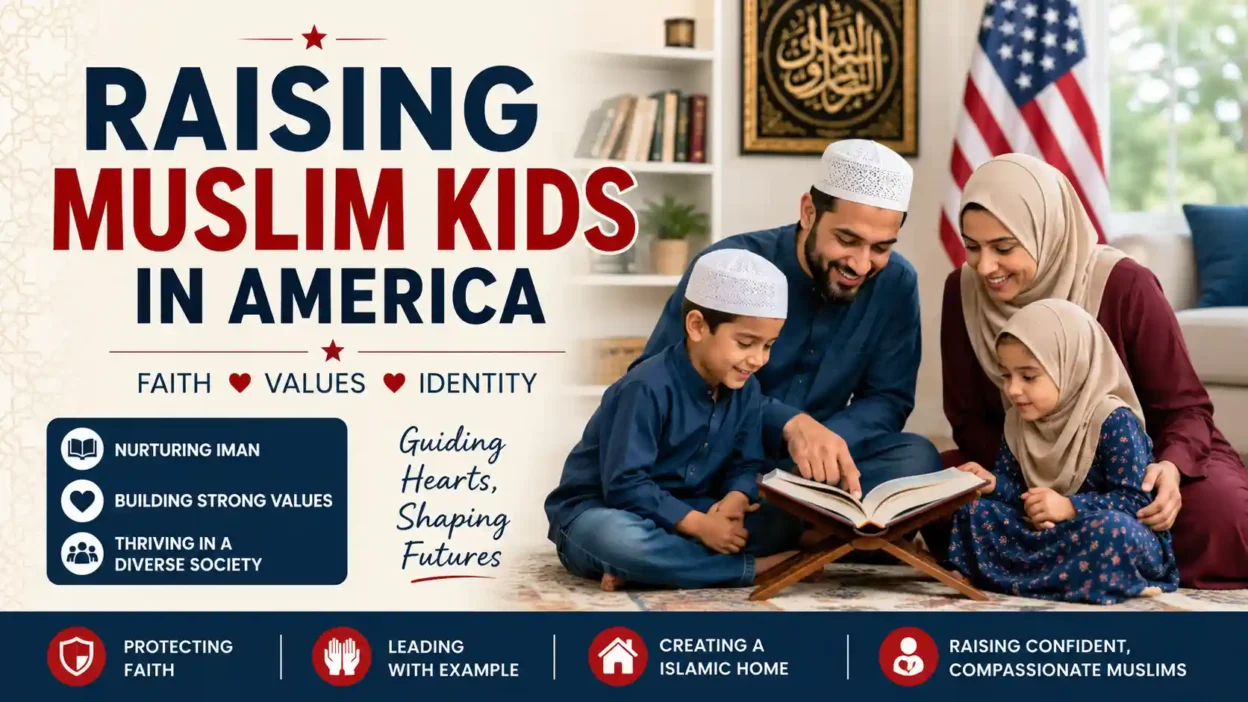
Raising children always comes with questions. For Muslim parents in America, some questions may feel even more personal.
How do you help your child feel proud of being Muslim? How do you explain Islam when classmates have different beliefs? What should you do when your child starts asking difficult questions about faith, friendships, clothing, holidays, or social media?
These questions do not mean you are failing as a parent. They are a normal part of raising children in a diverse society.
Raising Muslim kids in America is not about keeping children away from the world. It is about teaching them how to live in the world while staying connected to Allah, their values, and their family.
Children need more than rules. They need a safe home, good examples, honest conversations, Islamic knowledge, and parents who listen.
This guide will help you understand some of the most common challenges Muslim families face in America and practical ways to help children build a strong Muslim identity without making them feel isolated or afraid.
What Does It Mean to Raise Muslim Kids in America?
Raising Muslim children in America means helping them grow in both faith and everyday life.
Your child may attend an American public or private school, play sports with children from different backgrounds, have friends from many religions, and use the same social media platforms as millions of other young people.
None of this automatically means a child will lose their faith.
The goal is to give children a strong foundation so they can understand why they are Muslim, not simply hear that they must be Muslim.
A child who understands their faith can ask questions without feeling ashamed. They can meet people with different beliefs without feeling threatened. They can participate in school and community life while knowing which values matter to their family.
Parents can teach children that being Muslim includes prayer and worship, but it also includes honesty, kindness, patience, respect, responsibility, and good character.
The Qur’an reminds believers that families have a responsibility to protect themselves and their families from spiritual harm (Qur’an 66:6).
That responsibility begins at home.
Build Islam Into Everyday Family Life
Children learn much of what they believe through what they see.
If parents talk about prayer but rarely make time for salah, children notice. If parents tell them to speak kindly but regularly shout at others, children notice that too.
This is why example is one of the strongest forms of Islamic parenting.
You do not need to turn every day into an Islamic lesson. Small habits can have a lasting effect.
Say Bismillah before meals. Make dua together. Pray as a family when possible. Read a few verses of the Qur’an. Say Alhamdulillah when something good happens. Talk about Islamic values when real situations come up.
For example, if your child finds money at school, you can use the moment to talk about honesty. If a friend is being left out, talk about kindness. If your child loses a game, discuss patience and good sportsmanship.
These ordinary moments help children understand that Islam is not limited to the masjid.
Islam becomes part of life when children see it lived at home.
Teach Your Children Why They Are Muslim
One common mistake parents can make is focusing only on what children should do without explaining why.
A child may hear:
“You have to pray.”
“You cannot do that.”
“We do not celebrate this.”
But eventually, they may ask, “Why?”
Instead of avoiding the question, welcome it.
Explain Islamic beliefs in a language your child can understand. Talk about Allah’s mercy, creation, forgiveness, justice, and wisdom. Explain why Muslims pray and why the Qur’an matters.
As children become older, their questions may become more complex. They may ask about other religions, science, relationships, suffering, gender roles, morality, or why Muslims follow certain rules.
Do not treat every question as rebellion.
Sometimes a question is simply a question.
If you do not know the answer, say so. You can tell your child, “I am not sure. Let’s learn about it together.”
That response teaches something important: Islam does not require you to pretend you know everything.
For difficult religious questions, parents should seek reliable Islamic scholarship rather than depending on random social media posts.
Help Children Feel Proud of Their Muslim Identity
Children naturally want to fit in.
This can become especially noticeable during the school years. Your child may compare their clothes, food, holidays, family traditions, or religious practices with those of classmates.
Parents can help by creating a home where Muslim identity is presented with confidence and warmth.
This does not mean teaching children that Muslims are better than everyone else. It means helping them understand that they have something meaningful to be proud of.
Talk about Muslim contributions to science, medicine, literature, mathematics, architecture, and civilization.
Share stories of the Prophets and the companions in ways that connect with children’s lives.
Teach them that Muslims come from many cultures and countries. Islam is not limited to one language, race, or nationality.
A child should be able to say:
“I am Muslim, and I am comfortable being Muslim.”
That confidence can help them handle questions and social pressure without feeling that they need to hide an important part of themselves.
Make the Home a Safe Place for Difficult Questions
One of the most important things parents can give their children is a safe place to talk.
If children believe that every difficult question will lead to anger, punishment, or shame, they may stop asking their parents.
They may still have the questions.
They may simply take them somewhere else.
This becomes especially important during the teenage years.
Your child may eventually ask about something you consider inappropriate, confusing, or completely outside your family’s values. Your first reaction matters.
You can disagree with a behavior while still listening to the person.
Try phrases such as:
“Tell me what you think.”
“What made you ask that?”
“I am glad you came to me.”
“Let’s look at what Islam teaches about this.”
This does not mean parents should remove boundaries. Children still need limits.
It means boundaries can exist alongside trust.
A child who knows they can talk to their parents is more likely to seek guidance before making a serious decision.
Teach Children How to Handle Different Beliefs
American children often meet people from many religious and cultural backgrounds.
Your child may have Christian, Jewish, Hindu, atheist, Buddhist, or nonreligious classmates. They may attend birthday parties, school events, and community activities with people whose beliefs are different from theirs.
Teach them how to respond with respect without giving up their own beliefs.
They can be kind to someone without agreeing with everything that person believes.
They can ask respectful questions.
They can explain their own faith without insulting another person’s religion.
They can say, “In my family, we believe…” when explaining an Islamic practice.
This is an important life skill.
The Qur’an teaches Muslims to speak with wisdom and engage with others in a good manner. Respectful behavior is not a weakness. It is part of good character.
Children should learn that religious confidence does not require hostility toward others.
Talk About School Before Problems Begin
School is a major part of a child’s life, so parents should not wait for a problem before talking about it.
Ask about school regularly.
What did you learn today?
Who did you spend time with?
Did anything make you uncomfortable?
Did anyone ask you about being Muslim?
Did you have any problems during lunch, sports, or other activities?
These simple questions can open the door to bigger conversations.
Parents may also need to discuss practical matters such as salah during school hours, Ramadan, halal food, physical education, school trips, modest clothing, and religious holidays.
Every school is different, so parents should communicate respectfully with teachers and administrators when an accommodation or clarification is needed.
Children should also learn to advocate for themselves as they grow older.
A young child may need a parent to explain their needs. A teenager can gradually learn to explain their religious practices respectfully on their own.
That independence can become very valuable later in life.
Help Children Build Healthy Muslim Friendships
Family matters, but friendships matter too.
A child who never meets other Muslim children may sometimes feel that Islam is something only their family practices.
A healthy Muslim community can change that experience.
Look for opportunities through a local masjid, weekend Islamic school, youth group, sports program, community event, or family gathering.
The goal is not to force your child to become friends with every Muslim child they meet.
The goal is to give them opportunities to meet people who understand parts of their experience.
Good Muslim friendships can make Ramadan, Eid, salah, Qur’an learning, and other Islamic experiences feel normal and enjoyable.
At the same time, teach children that a Muslim friend is not automatically a good friend. Character matters.
A good friend should encourage honesty, respect, kindness, and responsible choices.
Parents can help children understand the difference between someone’s religious label and their actual behavior.
Teach Children About Social Media and Online Life
Modern parenting cannot ignore the internet.
Children may encounter Islamic content, anti-Islamic content, inappropriate material, influencers, arguments, misinformation, and peer pressure online.
Simply telling children, “Do not use social media,” may not always be enough, especially as they get older.
Teach them how to think.
Ask:
Who created this content?
What are they trying to make me believe?
Is this information supported by reliable evidence?
Is this Islamic advice coming from someone qualified to give it?
Does watching this content improve me or make me angry, anxious, or distracted?
Children also need practical online safety lessons. They should know not to share private information, meet online strangers in person without appropriate safeguards, or respond to harmful messages alone.
Most importantly, keep communication open.
If a child sees something disturbing online, they should know that coming to a parent will not automatically result in anger or punishment.
That trust can protect them.
Make Salah and Qur’an a Family Practice
Prayer should be important in a Muslim home, but children often need help developing the habit.
For younger children, keep expectations simple and age-appropriate.
Let them watch you pray. Give them a prayer space. Teach them short surahs gradually. Praise effort and improvement.
As children grow, help them understand the meaning behind salah.
Explain that prayer is not simply a task to complete. It is a direct act of worship and a regular reminder of Allah.
The same approach can be used with the Qur’an.
Instead of making Qur’an reading feel like endless homework, create small family routines.
Read a few verses together. Discuss one lesson. Listen to a recitation during a family drive. Talk about how a Qur’anic teaching applies to something happening in everyday life.
Consistency is usually more sustainable than intensity.
A small daily habit can become stronger than an occasional long session.
Handle Ramadan and Eid With Joy
Ramadan can be a beautiful time for Muslim children growing up in America.
It gives them a chance to experience something their classmates may not share.
Parents can make the month memorable through family meals, Qur’an, charity, storytelling, mosque visits, and simple traditions.
Children can help prepare iftar. They can choose someone to give charity to. They can decorate the home for Eid. They can help prepare Eid gifts.
Parents should also explain fasting according to age and ability. Young children do not need to be pushed into fasting beyond what is appropriate for them.
At school, children may need help explaining Ramadan to teachers and friends.
Simple language is enough:
“Ramadan is a special month for Muslims. We fast from dawn until sunset and spend more time in prayer and good deeds.”
Eid can also become a meaningful family tradition.
When children associate Islam with warm memories, family connection, generosity, and worship, religious practice can feel like part of who they are rather than a collection of restrictions.
Do Not Make Fear the Main Parenting Tool
Fear can sometimes change behavior quickly, but it is not a strong foundation for a lifelong relationship with Islam.
If every Islamic conversation focuses on punishment, children may eventually associate religion with fear rather than love and guidance.
Islam teaches both accountability and Allah’s mercy.
Children need to know that their choices matter. They also need to know that mistakes do not mean they are beyond Allah’s mercy.
When correcting a child, focus on the behavior rather than attacking their identity.
Instead of:
“You are a bad Muslim.”
Try:
“That choice was not right. Let’s talk about why.”
The difference is important.
A child who makes a mistake is still your child. They still need guidance.
Correct the behavior without destroying the relationship.
This approach can help children develop an internal sense of responsibility instead of simply behaving well because they are afraid of being caught.
Teach Good Character Alongside Religious Practice
A child can memorize surahs and still need to learn patience.
They can know how to pray and still need to learn honesty.
They can attend the masjid and still need to learn how to treat classmates kindly.
This is why akhlaq, or good character, should be central to Islamic parenting.
Teach children to keep promises, tell the truth, respect parents, care for neighbors, help people in need, control anger, and admit mistakes.
Praise these qualities when you see them.
If your child helps a younger sibling, notice it.
If they tell the truth after making a mistake, acknowledge their honesty.
If they stand up for someone being bullied, explain why that kindness matters.
Children learn that Islam is not only something they believe.
It is something they live.
Let Children Have a Healthy American Childhood
Being Muslim does not mean children must reject every part of American culture.
Muslim families can enjoy many ordinary activities: sports, parks, books, school events, hobbies, travel, volunteering, and time with friends.
The important question is whether an activity conflicts with Islamic principles.
Parents can teach children how to make that distinction.
Instead of creating a long list of everything they cannot do, help them develop judgment.
Ask:
Is this good for me?
Does this harm anyone?
Does it conflict with my faith?
Is there a better alternative?
Will I be comfortable with this choice later?
This teaches children how to think rather than simply how to obey.
As they become adults, they will face decisions without their parents standing beside them.
The goal of parenting is not lifelong control.
The goal is to prepare children to make wise choices when parents are not there.
Support Your Child When They Feel Different
There may be moments when your child feels like the only Muslim person in the room.
Maybe they are fasting while classmates are eating.
Maybe they are wearing hijab.
Maybe they do not participate in a particular holiday.
Maybe someone asks an uncomfortable question.
Do not dismiss these feelings.
Say, “I understand why that might feel difficult.”
Then help your child find a healthy response.
Sometimes the best answer is a simple explanation. Sometimes it is choosing not to engage. Sometimes a parent or teacher needs to become involved.
Teach children that being different is not automatically a problem.
At the same time, do not romanticize every difficulty. If your child is being bullied or discriminated against, take it seriously and work with the appropriate adults to address it.
Faith should give children strength, not require them to silently tolerate harm.
Build a Strong Muslim Family Culture
Children remember family culture.
They remember what Friday felt like. They remember Ramadan nights. They remember Eid mornings. They remember family meals, stories, jokes, visits, and conversations.
You can intentionally create positive traditions.
Have a weekly family meal.
Read a short Islamic story together.
Visit relatives.
Volunteer as a family.
Attend the masjid.
Make dua for one another.
Celebrate your child’s achievements.
Talk about gratitude.
These things may seem small, but they create a sense of belonging.
A strong Muslim identity is not built by one lecture.
It develops through hundreds of ordinary moments.
When Parents Make Mistakes
No parent gets everything right.
You may lose your patience. You may give the wrong answer. You may become too strict. You may become too relaxed. You may misunderstand what your child is trying to say.
That does not make you a bad Muslim parent.
When you make a mistake, apologize.
Saying “I was wrong” can teach your child more about humility than a long lecture.
Make dua for wisdom. Seek knowledge. Talk to trusted people. Keep improving.
Allah does not ask parents to be perfect.
Parents should strive to fulfill their responsibility with sincerity and trust in Him.
The Prophet Muhammad ﷺ taught the importance of kindness and good treatment toward children, and his example shows that compassion is a central part of raising the next generation.
Final Thoughts on Raising Muslim Kids in America
Raising Muslim kids in America is a long journey, not a one-time project.
There will be easy years and difficult ones. Your child may become excited about Islam one year and ask challenging questions the next. They may love going to the masjid as a child and become less interested during their teenage years. Do not panic over every change. Keep the relationship strong. Keep teaching. Keep listening. Keep making dua. Most importantly, remember that your child needs both guidance and love. Teach Islam clearly, but show its beauty through your character. Set boundaries, but leave room for conversation. Encourage salah, Qur’an, and Islamic learning, but also help your child understand their purpose. Let your home be a place where your children can return when they are confused. Let them know that questions are welcome.
Let them see that faith can coexist with kindness, education, curiosity, and responsible participation in American society. You are not responsible for controlling every influence your child will ever encounter. You are responsible for giving them a strong foundation. Make that foundation one of iman, knowledge, character, family, and trust in Allah. With Allah’s help, your child can grow into a confident Muslim who knows their faith, respects others, thinks carefully, and contributes positively to the society around them.
May Allah guide our children, protect their hearts, strengthen their iman, bless their friendships, give them beneficial knowledge, and make them a source of goodness for their families and communities.
Ameen.
Frequently Asked Questions
1. How can I raise a Muslim child in America without making them feel isolated?
Help your child build both a strong Muslim identity and healthy connections with the wider community. Encourage friendships, school activities, sports, education, and respectful relationships while keeping Islamic values at the center of family life.
2. How do I keep my children connected to Islam as they grow older?
Focus on understanding rather than rules alone. Make prayer, Qur’an, family discussions, Ramadan, and Islamic learning part of normal life. Most importantly, keep communication open so your child feels comfortable discussing difficult questions.
3. What should I do if my child questions Islam?
Listen before correcting. Questions do not automatically mean that a child has rejected Islam. Try to understand what they are really asking, provide a thoughtful answer, and seek qualified Islamic guidance when necessary.
4. How can Muslim children handle pressure from American schools and friends?
Teach them their values before difficult situations arise. Help them practice respectful ways to say no, explain their beliefs, and make independent decisions. A child with confidence and a strong relationship with their parents is often better prepared to handle peer pressure.
5. Should Muslim parents allow their children to participate in American culture?
Muslim families can participate in many parts of American society while maintaining Islamic principles. Parents should teach children how to distinguish between ordinary cultural activities and practices that conflict with their religious beliefs.

PrayerLoomz is a faith-centered platform dedicated to helping Muslims find meaningful prayers, duas, Quranic guidance, and Islamic reminders for everyday life. Our content is written with respect for Islamic teachings and aims to provide simple, reliable, and spiritually uplifting guidance for Muslims around the world. We focus on prayers for different life situations, Islamic duas, Quran verses, authentic Hadith references, and practical faith-based reminders. Our goal is to make Islamic knowledge easier to understand while encouraging readers to strengthen their connection with Allah SWT. At PrayerLoomz, we value accuracy, sincerity, and respectful presentation of Islamic teachings. We encourage readers to verify matters of religious ruling with qualified Islamic scholars when necessary.