
There are moments when the heart feels too tired to explain what it needs. A few years ago, a Muslim friend told me that during a difficult season in his life, he stopped trying to find perfect words and began learning duas from Sunnah.
He would sit quietly after prayer and repeat the supplications taught by Prophet Muhammad ﷺ. Slowly, those short words became a source of comfort, hope, and trust in Allah SWT.
That is the beauty of Sunnah duas. They teach us how to turn to Allah SWT in happiness, fear, hardship, gratitude, and uncertainty. They are not simply words to memorize. They help shape the way we think and strengthen our relationship with our Creator.
If you are searching for duas from Sunnah, this guide is written for you. Whether you are new to Islamic supplications or want to build a daily habit, these powerful duas can become part of your everyday life.
Each one carries a beautiful meaning and teaches us to depend on Allah SWT while taking practical steps in our lives.
1. Dua From Sunnah for Guidance and Righteousness
Life gives us many choices. Sometimes we know what we want but do not know what is best for us. This is when we need Allah’s guidance more than our own judgment.
The Prophet Muhammad ﷺ used to make this beautiful dua:
Arabic:
اللَّهُمَّ إِنِّي أَسْأَلُكَ الْهُدَى وَالتُّقَى وَالْعَفَافَ وَالْغِنَى
Transliteration:
Allahumma inni as’alukal-huda wat-tuqa wal-‘afafa wal-ghina.
Meaning:
“O Allah, I ask You for guidance, piety, purity, and sufficiency.”
This dua is short, but its meaning is deep. It asks Allah SWT for guidance, protection from sinful desires, purity, and freedom from unhealthy dependence on people. It can be especially meaningful when you are making an important decision, starting a new chapter, or trying to become closer to Allah.
Make this short dua from Sunnah part of your daily routine. Ask Allah to guide your choices, protect your heart, and give you contentment with what He provides. The Prophet ﷺ taught this supplication, and it is recorded in Jami` at-Tirmidhi 3489.
2. Dua From Sunnah for Forgiveness and a New Beginning
Everyone makes mistakes. Sometimes a person carries guilt for so long that they begin to believe they are too far from Allah SWT. Islam teaches the opposite. The door of repentance remains open.
One of the greatest duas from Sunnah for seeking forgiveness is known as Sayyid al-Istighfar.
Arabic:
اللَّهُمَّ أَنْتَ رَبِّي لَا إِلَهَ إِلَّا أَنْتَ، خَلَقْتَنِي وَأَنَا عَبْدُكَ، وَأَنَا عَلَى عَهْدِكَ وَوَعْدِكَ مَا اسْتَطَعْتُ، أَعُوذُ بِكَ مِنْ شَرِّ مَا صَنَعْتُ، أَبُوءُ لَكَ بِنِعْمَتِكَ عَلَيَّ، وَأَبُوءُ لَكَ بِذَنْبِي، فَاغْفِرْ لِي، فَإِنَّهُ لَا يَغْفِرُ الذُّنُوبَ إِلَّا أَنْتَ
Transliteration:
Allahumma anta Rabbi la ilaha illa anta, khalaqtani wa ana ‘abduka, wa ana ‘ala ‘ahdika wa wa’dika mastata’tu, a’udhu bika min sharri ma sana’tu, abu’u laka bini’matika ‘alayya, wa abu’u laka bidhanbi faghfir li fa innahu la yaghfirudh-dhunuba illa anta.
Meaning:
“O Allah, You are my Lord. There is no god worthy of worship except You. You created me and I am Your servant. I acknowledge Your blessings and my sins, so forgive me.”
This powerful Sunnah dua teaches honesty. We admit our mistakes without losing hope. We also remember Allah’s blessings.
The Prophet ﷺ described this as the best way of seeking forgiveness. It is reported in Sahih al-Bukhari 6306.
3. Dua From Sunnah for Protection From Anxiety and Hardship
Some days feel heavier than others. You may have financial pressure, family problems, work stress, or fears about the future. In such moments, Islam teaches us to turn toward Allah instead of allowing worry to control the heart.
A well-known Sunnah supplication for seeking protection from several forms of difficulty includes asking Allah for refuge from anxiety, weakness, debt, and other trials.
Arabic:
اللَّهُمَّ إِنِّي أَعُوذُ بِكَ مِنَ الهَمِّ وَالْحَزَنِ، وَأَعُوذُ بِكَ مِنَ العَجْزِ وَالْكَسَلِ، وَأَعُوذُ بِكَ مِنَ الجُبْنِ وَالبُخْلِ، وَأَعُوذُ بِكَ مِنْ غَلَبَةِ الدَّيْنِ وَقَهْرِ الرِّجَالِ
Transliteration:
Allahumma inni a’udhu bika minal-hammi wal-hazan, wa a’udhu bika minal-‘ajzi wal-kasal, wa a’udhu bika minal-jubni wal-bukhl, wa a’udhu bika min ghalabatid-dayni wa qahrir-rijal.
Meaning:
“O Allah, I seek refuge in You from anxiety and sorrow, from weakness and laziness, from cowardice and miserliness, and from the burden of debt and being overcome by people.”
This dua reminds us that emotional and practical struggles can be brought to Allah SWT. It does not mean we stop seeking solutions. Instead, we ask Allah for strength while taking responsible action.
Use this spiritual dua from Sunnah when your heart feels overwhelmed. Let its words remind you that your problems are never beyond Allah’s knowledge and power.
4. Dua From Sunnah for Reliance on Allah
There are times when you have done everything you can, but the result is still outside your control. You applied for the job. You studied for the exam. You tried to repair the relationship. Now you must leave the outcome with Allah.
The Prophet ﷺ taught many supplications that develop trust and dependence upon Allah SWT.
A beautiful dua for guidance and protection is:
Arabic:
اللَّهُمَّ أَلْهِمْنِي رُشْدِي وَأَعِذْنِي مِنْ شَرِّ نَفْسِي
Transliteration:
Allahumma alhimni rushdi wa a’idhni min sharri nafsi.
Meaning:
“O Allah, inspire me with my guidance and protect me from the evil of my own self.”
This dua from Sunnah for strength is especially meaningful because sometimes our greatest struggle is inside us. Fear, anger, pride, impatience, and temptation can affect our decisions.
Ask Allah SWT to guide your thoughts and actions. Ask Him to protect you from choices that may harm your faith or future. This supplication is reported in Jami` at-Tirmidhi 3483.
5. Dua From Sunnah Before Sleeping
Nighttime is a beautiful opportunity to slow down and remember Allah. After a busy day, the heart needs a moment of surrender.
The Prophet Muhammad ﷺ taught a specific dua to say before sleeping:
Arabic:
اللَّهُمَّ أَسْلَمْتُ نَفْسِي إِلَيْكَ، وَوَجَّهْتُ وَجْهِي إِلَيْكَ، وَفَوَّضْتُ أَمْرِي إِلَيْكَ، وَأَلْجَأْتُ ظَهْرِي إِلَيْكَ، رَغْبَةً وَرَهْبَةً إِلَيْكَ
Transliteration:
Allahumma aslamtu nafsi ilaika, wa wajjahtu wajhi ilaika, wa fawwadtu amri ilaika, wa alja’tu zahri ilaika, raghbatan wa rahbatan ilaika.
Meaning:
“O Allah, I submit myself to You, turn my face to You, entrust my affairs to You, and rely upon You.”
The full supplication continues with seeking refuge and affirming belief in Allah’s Book and His Messenger ﷺ.
This daily dua from Sunnah teaches something beautiful: before sleeping, let go of the worries you cannot control. You can plan tomorrow, but tonight belongs to Allah.
The Prophet ﷺ taught this supplication before going to bed, as recorded in Sahih al-Bukhari 6315.
6. Dua From Sunnah for Guidance, Purity, and Contentment
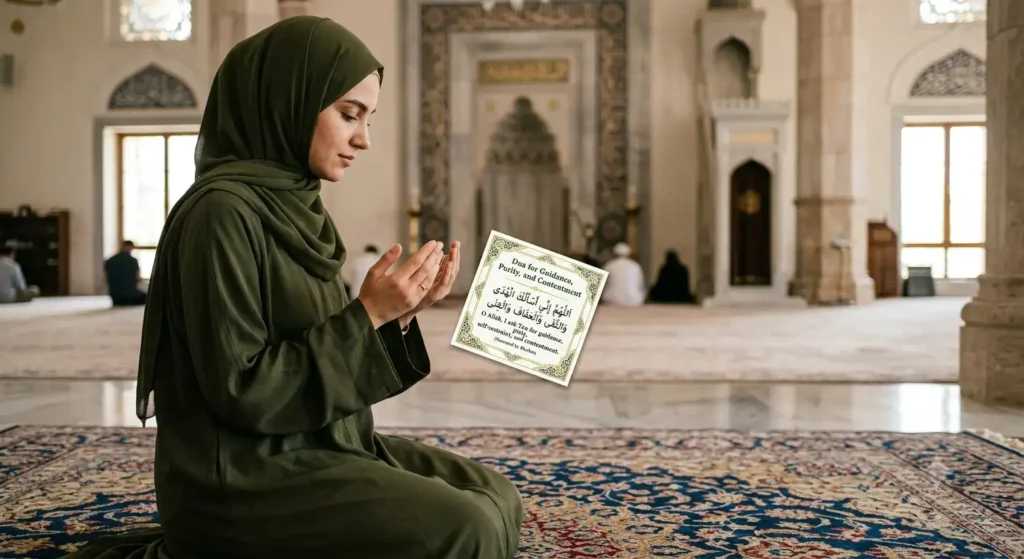
Modern life can make people constantly compare themselves with others. Someone else may have a better home, career, relationship, or financial situation. Comparison can quietly steal gratitude.
The Prophet ﷺ taught us to ask Allah for guidance, piety, chastity, and sufficiency:
Arabic:
اللَّهُمَّ إِنِّي أَسْأَلُكَ الْهُدَى وَالتُّقَى وَالْعَفَافَ وَالْغِنَى
Transliteration:
Allahumma inni as’alukal-huda wat-tuqa wal-‘afafa wal-ghina.
Meaning:
“O Allah, I ask You for guidance, piety, purity, and sufficiency.”
This simple dua is a beautiful reminder that success is not only about having more. True success also means having a heart that is guided, clean, modest, and content.
Say this short dua from Sunnah when you feel distracted by worldly pressure. Ask Allah to give you what is good for your faith and life.
You can also teach it to your children or family because it is easy to memorize. The Prophet ﷺ used this supplication, and it is recorded as a sound hadith in Jami` at-Tirmidhi.
7. Dua From Sunnah for a Stronger Relationship With Allah
A Muslim’s greatest goal is not simply to receive worldly blessings. It is to live with the love of Allah SWT and become closer to Him.
A reported supplication connected with the love of Allah asks:
Arabic:
اللَّهُمَّ إِنِّي أَسْأَلُكَ حُبَّكَ وَحُبَّ مَنْ يُحِبُّكَ وَالْعَمَلَ الَّذِي يُبَلِّغُنِي حُبَّكَ
Transliteration:
Allahumma inni as’aluka hubbaka wa hubba man yuhibbuka wal-‘amalalladhi yuballighuni hubbak.
Meaning:
“O Allah, I ask You for Your love, the love of those who love You, and the deeds that bring me to Your love.”
This is a beautiful spiritual dua because it connects love with action. Loving Allah is not only an emotion. It should influence how we pray, speak, treat people, earn money, use our time, and respond to difficulties.
Ask Allah to make obedience beloved to you. Ask Him to bring good people into your life and help you perform deeds that bring you closer to Him.
This supplication is reported in Jami` at-Tirmidhi 3490.
8. Dua From Sunnah for Peace Before Sleep
Sometimes the body is tired, but the mind refuses to rest. Thoughts about tomorrow keep coming. Regrets from yesterday return. In these moments, remembering Allah can help bring the heart back to surrender.
The Prophet ﷺ taught:
Arabic:
بِاسْمِكَ اللَّهُمَّ أَمُوتُ وَأَحْيَا
Transliteration:
Bismika Allahumma amutu wa ahya.
Meaning:
“In Your name, O Allah, I die and I live.”
It is a very short dua, but it carries a powerful message. Sleep reminds us of our complete dependence on Allah. We cannot control what happens while we sleep, so we place ourselves in His care.
Make this short Sunnah dua part of your bedtime routine. Say it slowly instead of rushing through it. Think about its meaning and allow your heart to surrender the day to Allah SWT.
The Prophet ﷺ is reported to have said this when going to sleep. The narration is recorded in Sahih al-Bukhari 6324.
9. Dua From Sunnah for a Good Morning
Every morning is another gift from Allah. You may wake up with plans, responsibilities, worries, or excitement. Before reaching for your phone, take a moment to remember the One who gave you another day.
The Prophet ﷺ would say after waking:
Arabic:
الْحَمْدُ لِلَّهِ الَّذِي أَحْيَانَا بَعْدَ مَا أَمَاتَنَا وَإِلَيْهِ النُّشُورُ
Transliteration:
Alhamdu lillahil-ladhi ahyana ba’da ma amatana wa ilaihin-nushur.
Meaning:
“All praise is for Allah who gave us life after causing us to die, and to Him is the resurrection.”
This daily dua from Sunnah begins the day with gratitude. Instead of immediately focusing on problems, you first recognize a blessing: you are alive.
Try saying this dua when you wake up. Then make a simple personal dua for your family, work, health, faith, and the day ahead.
The supplication is recorded in Sahih al-Bukhari 6324.
10. Dua From Sunnah for Complete Surrender to Allah
One of the deepest lessons from the Sunnah is learning to trust Allah while still doing your part.
The Prophet ﷺ taught a bedtime supplication that includes the words:
Arabic:
لَا مَلْجَأَ وَلَا مَنْجَا مِنْكَ إِلَّا إِلَيْكَ
Transliteration:
La malja’a wa la manja minka illa ilaik.
Meaning:
“There is no refuge and no escape from You except toward You.”
These words can change how we see difficult situations. Allah SWT is not someone we turn to only after everything else fails. He is the One we turn to from the beginning.
If you are worried about your future, family, work, finances, or faith, bring that concern to Allah. Make your effort, seek wise advice, and then place your trust in Him.
This powerful dua from Sunnah can remind the heart that real safety and ultimate refuge belong to Allah alone. The complete supplication is recorded in Sahih al-Bukhari 6311 and 6315.
How to Make Duas From Sunnah Part of Your Daily Life
Learning many duas at once can feel difficult. You do not need to memorize everything in one day. Start with one supplication and use it consistently.
A simple routine can look like this:
- Morning: Begin with the dua for waking up and thank Allah for another day.
- After prayer: Spend a few quiet moments asking Allah for guidance and forgiveness.
- During stress: Use a Sunnah dua that asks Allah for protection from worry, weakness, and hardship.
- Before important decisions: Ask Allah for guidance and what is best for your faith and life.
- Before sleep: Recite the Sunnah supplications for bedtime and surrender your affairs to Allah.
- During repentance: Make Sayyid al-Istighfar and sincerely turn back to Allah.
- During happiness: Remember that every blessing comes from Allah and respond with gratitude.
The goal is not to rush through a long list. The goal is to understand what you are saying and build a relationship with Allah through those words.
Why Duas From Sunnah Matter
Sunnah duas give Muslims a beautiful model for turning to Allah in everyday situations. They cover many parts of life, including guidance, forgiveness, fear, gratitude, sleep, hardship, and spiritual growth.
They also teach balance. A Muslim asks Allah for help but still takes action. A person seeks forgiveness but does not give up hope. A person asks for provision but continues to work. A person asks for guidance while making thoughtful decisions.
Most importantly, these supplications teach the heart to remember Allah regularly.
You do not need perfect circumstances before making dua. You can make dua when you are tired. You can make dua when you are happy. You can make dua when you have made a mistake. You can make dua when you do not know what to do next.
That constant connection is one of the greatest gifts of supplication.
Conclusion
Duas from Sunnah are more than beautiful words to memorize. They are lessons in faith, humility, gratitude, repentance, patience, and trust in Allah SWT. Each supplication taught by Prophet Muhammad ﷺ gives us a way to turn toward Allah during a specific moment of life. You may not remember every dua today, and that is completely fine. Start small. Learn one short supplication. Understand its meaning. Repeat it each day until it becomes natural. Then add another.
Make your daily duas from Sunnah part of your morning, prayers, quiet moments, and bedtime routine. When life becomes difficult, let these words remind you that you are not alone. When life becomes easy, let them teach you gratitude. Never underestimate a sincere dua. A few words spoken with a humble heart can become a powerful act of worship.
May Allah SWT guide us, forgive our mistakes, strengthen our faith, protect our families, ease our hardships, and accept our duas. May He make the Sunnah beloved to our hearts and keep our tongues busy with words that bring us closer to Him. Ameen.
FAQs
1. What are duas from Sunnah?
Duas from Sunnah are supplications taught or practiced by Prophet Muhammad ﷺ. They cover many parts of daily life, including sleeping, waking, seeking forgiveness, asking for guidance, and dealing with hardship. Learning them helps Muslims follow the example of the Prophet ﷺ.
2. What is a good short dua from Sunnah?
One simple example is: Allahumma inni as’alukal-huda wat-tuqa wal-‘afafa wal-ghina, meaning, “O Allah, I ask You for guidance, piety, purity, and sufficiency.” It is easy to memorize and has a broad, meaningful message.
3. Can I make Sunnah duas in English?
Yes. Understanding the meaning is very important, especially when learning a dua. For formal acts of worship where Arabic wording has specific requirements, follow reliable Islamic guidance. Outside those specific requirements, you can also ask Allah SWT for your personal needs in your own language.
4. Which Sunnah dua should I learn first?
Start with a dua that fits your daily routine. The waking dua and bedtime duas are good choices because you can practice them every day. Once you know one well, add another. Consistency is better than trying to memorize many duas at once.
5. How often should I make duas from Sunnah?
You can use Sunnah supplications at the times and occasions taught in the authentic narrations. Some are connected with specific situations, such as sleeping or waking, while others can be used more generally. The important thing is to make dua sincerely and understand the words you are saying.

PrayerLoomz is a faith-centered platform dedicated to helping Muslims find meaningful prayers, duas, Quranic guidance, and Islamic reminders for everyday life. Our content is written with respect for Islamic teachings and aims to provide simple, reliable, and spiritually uplifting guidance for Muslims around the world. We focus on prayers for different life situations, Islamic duas, Quran verses, authentic Hadith references, and practical faith-based reminders. Our goal is to make Islamic knowledge easier to understand while encouraging readers to strengthen their connection with Allah SWT. At PrayerLoomz, we value accuracy, sincerity, and respectful presentation of Islamic teachings. We encourage readers to verify matters of religious ruling with qualified Islamic scholars when necessary.