I still remember learning Wudu from my father when I was young. Before every prayer, he would slowly wash his hands and face and remind me that we were not only cleaning our bodies but also preparing our hearts to stand before Allah.
Those simple moments taught me that Wudu is a beautiful act of worship filled with peace and mindfulness. If you are searching for ablution wudu steps, this guide is written for you.
Whether you are a new Muslim, returning to prayer, or teaching your children, understanding the correct way to perform Wudu can strengthen your connection with Allah.
Wudu is more than a ritual. It brings cleanliness, calmness, and spiritual focus into daily life. Every time a believer performs Wudu, it becomes a reminder to leave distractions behind and prepare for Salah with sincerity.
In this guide, you will learn the correct step-by-step Wudu method, its importance in Islam, common mistakes to avoid, and the spiritual benefits of this beautiful act of purification.
What Is Wudu in Islam?
Wudu, also known as Islamic ablution, is the act of purification that Muslims perform before Salah and certain acts of worship.
Allah says in the Quran:
“O you who believe! When you stand up for prayer, wash your faces and your hands up to the elbows, wipe your heads, and wash your feet up to the ankles.” (Quran 5:6)
This verse shows that Wudu is not optional. It is an important preparation for prayer and a symbol of purity in Islam.
Why Is Wudu Important?
Wudu has both spiritual and physical benefits.
Spiritual Benefits
- Prepares the heart for prayer.
- Helps a believer become mindful of Allah.
- Removes minor sins.
- Creates inner peace and focus.
The Prophet Muhammad ﷺ said:
“When a Muslim performs Wudu, his sins leave his body with the water.” (Sahih Muslim)
Physical Benefits
- Promotes cleanliness and hygiene.
- Refreshes the body.
- Encourages regular washing throughout the day.
- Helps a person feel calm and renewed.
When Is Wudu Required?
Wudu is required before:
- Performing Salah.
- Touching the Mushaf according to many scholars.
- Tawaf around the Kaaba.
You should renew your Wudu if it is broken by:
- Using the restroom.
- Passing gas.
- Deep sleep.
- Loss of consciousness.
Conditions Before Performing Wudu
Before beginning Wudu, make sure that:
- Clean water is available.
- Any impurity on the body is removed.
- Water can reach the skin.
- Thick substances blocking water are removed.
For example, waterproof paint or certain cosmetics may prevent water from reaching the skin.
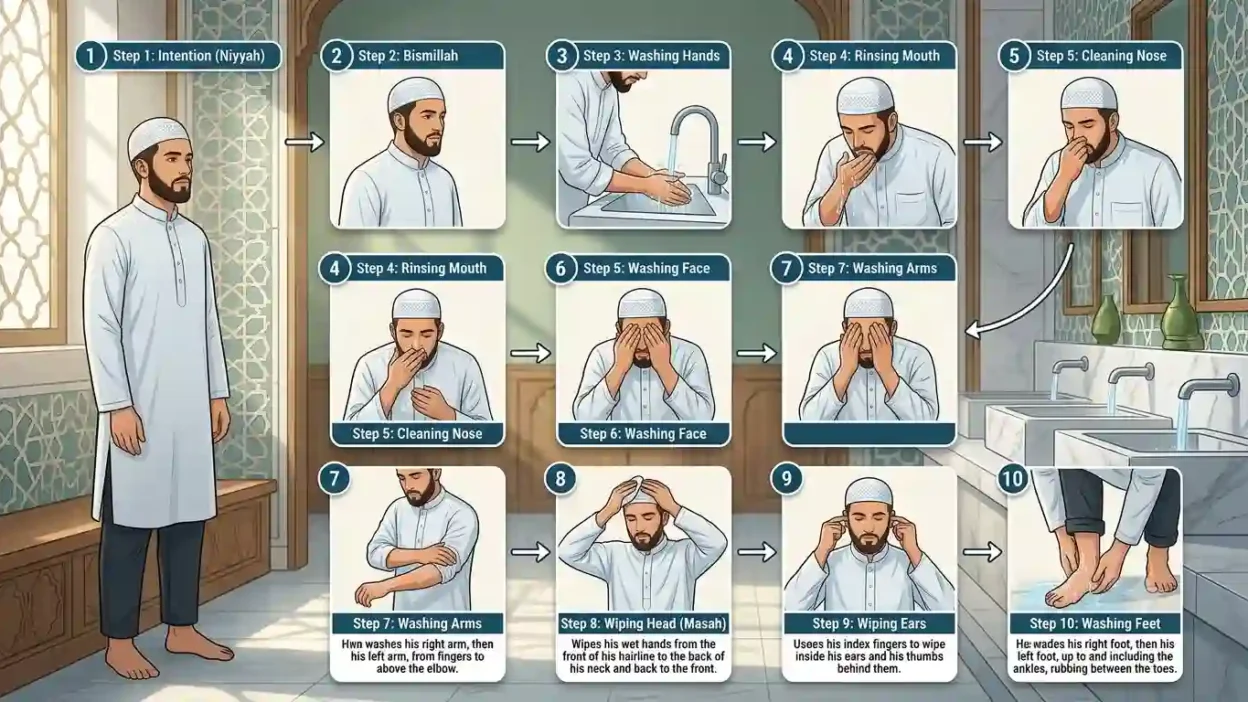
Ablution Wudu Steps: Step-by-Step Guide
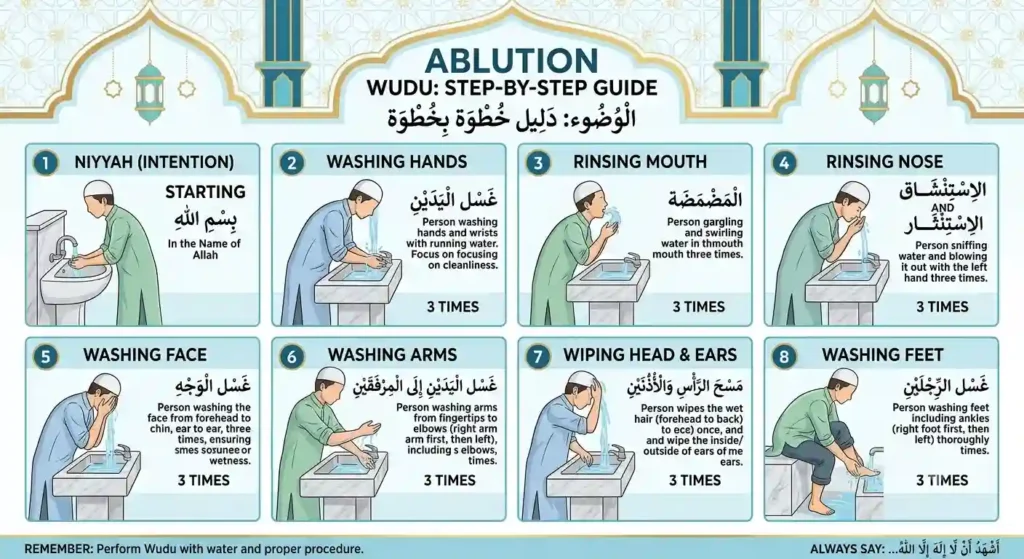
Step 1: Make Intention (Niyyah)
Make the intention in your heart that you are performing Wudu for the sake of Allah.
You do not need to say anything aloud. A sincere intention is enough.
Step 2: Say Bismillah
Begin by saying:
بِسْمِ اللهِ
Bismillah
Meaning: In the name of Allah.
This reminds us that even simple actions become acts of worship when done for Allah.
Step 3: Wash Both Hands Three Times
Wash both hands thoroughly up to the wrists three times.
Make sure water reaches between the fingers.
Step 4: Rinse the Mouth Three Times
Take water into your mouth and rinse it three times.
This prepares the mouth for reciting the Quran and remembering Allah.
Step 5: Clean the Nose Three Times
Sniff water gently into the nose and blow it out three times.
This Sunnah practice also helps maintain cleanliness.
Step 6: Wash the Face Three Times
Wash the entire face from the hairline to the chin and from one ear to the other.
The Prophet ﷺ encouraged believers to perform Wudu carefully and completely.
Step 7: Wash the Arms Up to the Elbows
Wash the right arm first and then the left arm three times.
Ensure that water reaches every part of the arm, including the elbows.
Step 8: Wipe the Head Once
Wet your hands and wipe your head once from front to back and back again.
This action is called Masah.
Step 9: Wipe the Ears
Using the moisture left on your hands, wipe inside and behind both ears once.
Step 10: Wash the Feet Up to the Ankles
Wash the right foot first and then the left foot three times.
Make sure water reaches between the toes and around the ankles.
Quick Summary Table of Wudu Steps
| Step | Action | Number of Times |
| 1 | Intention | Once |
| 2 | Say Bismillah | Once |
| 3 | Wash Hands | Three |
| 4 | Rinse Mouth | Three |
| 5 | Clean Nose | Three |
| 6 | Wash Face | Three |
| 7 | Wash Arms | Three |
| 8 | Wipe Head | Once |
| 9 | Wipe Ears | Once |
| 10 | Wash Feet | Three |
Dua After Completing Wudu
After finishing Wudu, recite:
أَشْهَدُ أَنْ لَا إِلَهَ إِلَّا اللهُ وَحْدَهُ لَا شَرِيكَ لَهُ وَأَشْهَدُ أَنَّ مُحَمَّدًا عَبْدُهُ وَرَسُولُهُ
Transliteration:
Ashhadu an la ilaha illallahu wahdahu la sharika lahu wa ashhadu anna Muhammadan abduhu wa rasuluh.
Meaning:
“I bear witness that there is no god except Allah alone, without a partner, and I bear witness that Muhammad is His servant and Messenger.”
The Prophet ﷺ said that the gates of Paradise are opened for the person who recites this dua after Wudu.
Common Mistakes During Wudu
Many people make small mistakes while performing Wudu.
1. Washing Too Quickly
Some people rush and leave parts of the body dry.
2. Forgetting the Correct Order
Following the Sunnah order is important.
3. Wasting Water
The Prophet ﷺ taught moderation even when water was plentiful.
4. Missing Areas
Commonly missed places include:
- Between fingers
- Between toes
- Behind the ears
- Around the elbows and ankles
Benefits of Performing Wudu Daily
1. Spiritual Peace
Wudu helps believers feel calm and connected to Allah.
2. Better Focus in Prayer
Purification prepares the mind and heart for Salah.
3. Daily Hygiene
Since Muslims pray several times a day, Wudu naturally promotes cleanliness.
4. Constant Reminder of Faith
Every act of Wudu reminds a believer to live with sincerity and gratitude.
5. Removal of Minor Sins
The Prophet ﷺ taught that sins are washed away during Wudu.
Teaching Wudu to Children and New Muslims

Learning Wudu can seem difficult at first, but it becomes easy with practice.
Helpful tips include:
- Teach one step at a time.
- Demonstrate each action slowly.
- Use simple language.
- Encourage questions.
- Practice together before Salah.
Parents and teachers should make Wudu a positive and enjoyable learning experience.
Conclusion
The ablution Wudu steps are among the most beautiful acts of worship in Islam. They teach believers cleanliness, discipline, and mindfulness before standing in prayer. Wudu is not merely washing different parts of the body. It is a moment to slow down, remember Allah, and prepare the heart for worship. Every drop of water becomes a reminder of Allah’s mercy and forgiveness. By learning the correct Wudu step-by-step method, you can perform your prayers with confidence and peace of mind. Whether you are a beginner or simply refreshing your knowledge, making Wudu part of your daily routine can strengthen your faith and bring comfort to your life.
May Allah accept our purification, our prayers, and our efforts to draw closer to Him. Ameen.
Frequently Asked Questions
1. What are the basic ablution Wudu steps?
The basic steps are intention, saying Bismillah, washing the hands, mouth, nose, face, arms, wiping the head and ears, and washing the feet.
2. Can I pray without Wudu?
No. Wudu is generally required before Salah unless a person has a valid excuse according to Islamic rulings.
3. What breaks Wudu?
Using the restroom, passing gas, deep sleep, and loss of consciousness are among the common things that invalidate Wudu.
4. How long does Wudu remain valid?
Wudu remains valid until something occurs that breaks it. There is no fixed time limit.
5. Is Wudu necessary before reading the Quran?
Many scholars recommend or require Wudu before touching the Mushaf, while reciting from memory does not necessarily require Wudu.